Features
Personalised and categorised playlists are what differentiates Spotify from so many other music streaming platforms. To create these, Spotify relies on audio features for every track on their platform, which can be accessed through Spotify’s Web API. Out of the 13 features, 6 features were selected for analysis. Each feature has a value ranging from 0 to 1.0. The description for this is as follows:
Danceability - Describes how suitable a track is for dancing based on a combination of musical elements comprising of its beats per minute (bpm), tempo, rhythm stability and beat strength.
Energy - Represents a perceptual measure of intensity and activity, attributed by features like the track’s dynamic range, timbre, and onset rate. Typically, energetic tracks feel fast, loud and noisy.
Speechiness - This detects the presence of spoken words in a track. The more exclusively speech-like the recording (e.g. talk show, audio book, poetry), the closer to 1.0 the value.
Liveness - Detects the presence of an audience in the recording. Higher liveness values represent an increased probability that the track was performed live.
Valence - Describes the musical positiveness conveyed by a track. Tracks with high valence sound more positive, while tracks with low valence sound more negative.
Overview of features
First, let’s take a look at the average values of each feature for the top 50 songs of 2020.
The top songs are high in danceability, energy and positivity. Liveness and speechiness don’t matter as much, with their lower values. This could suggest that most of the top songs probably are recorded properly in a studio, and not performed live. Low speechiness also indicates that having lines of lyrics aren’t particularly important; top songs probably focus more on the musical melody.
The moods we’re searching for when listening to music
Our brain responds to external stimulus such as music, and research has shown that music stimulates the part of the brain that produces dopamine. The way we respond to songs is highly personal and evokes certain emotions. When listening to music, are we searching for a specific mood?
We create an emotional quadrant using the energy and valence features. Low energy/low valence songs are categorized as “sad”, low valence/high energy ones are “angry”, those with high valence and low energy are “calm” while those having high values for both are “happy”.
As we can see, happy or angry songs dominate the charts. Such songs are much more likely to end up in the top global songs of the year. As a collective, we probably listen to music to purposely evoke these stronger emotions.
Spotify themselves use these parameters to automatically build their mood-based playlists. You can find a Spotify-generated playlist for practically every mood you have, whether that’s “Mood Booster”, “Chill Hits”, or my favorite, “songs to scream in the car”.
A release strategy: single or album?
The debate of whether to release a single or an album is a long-standing topic of discussion. Top 2020 song data shows that singles have a slightly higher average popularity than albums.
However, the general consensus is to release both! As a music listener, I honestly don’t really specifically look for either a single or an album, I’ll listen to whatever song my favorite artist comes out with.
Which artist dominated the charts in 2020?
If the previous statistics have made you think of specific songs, you might have a few artists in mind. The dashboard shows the artists with the number of their songs that have appeared in the top songs playlist, with a boxplot distribution of the rankings of their songs.
The filter can be applied to select artists with a selected number of songs appearing on the playlist.
Billie Eilish, Dua Lipa, and Travis Scott top the charts. Dua Lipa’s song ranking distribution is the widest, while Travis’ rankings are concentrated in the last quarter of the list.
We’ve established that the top songs are high in danceability, energy and valence. Let’s take a look at a radar chart comparing each top artist’s song features to the averages we’ve obtained from above, to see if they match up.
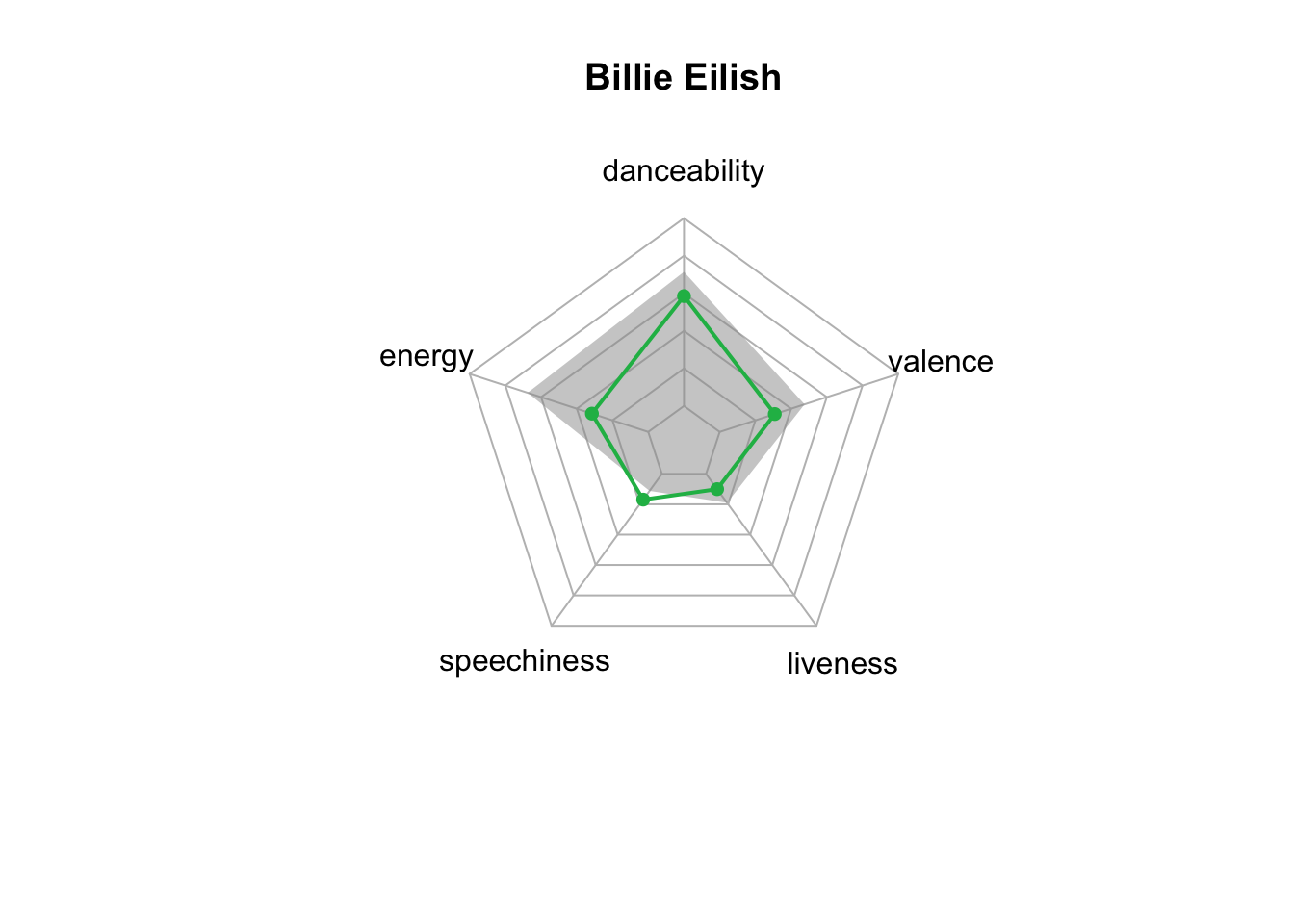
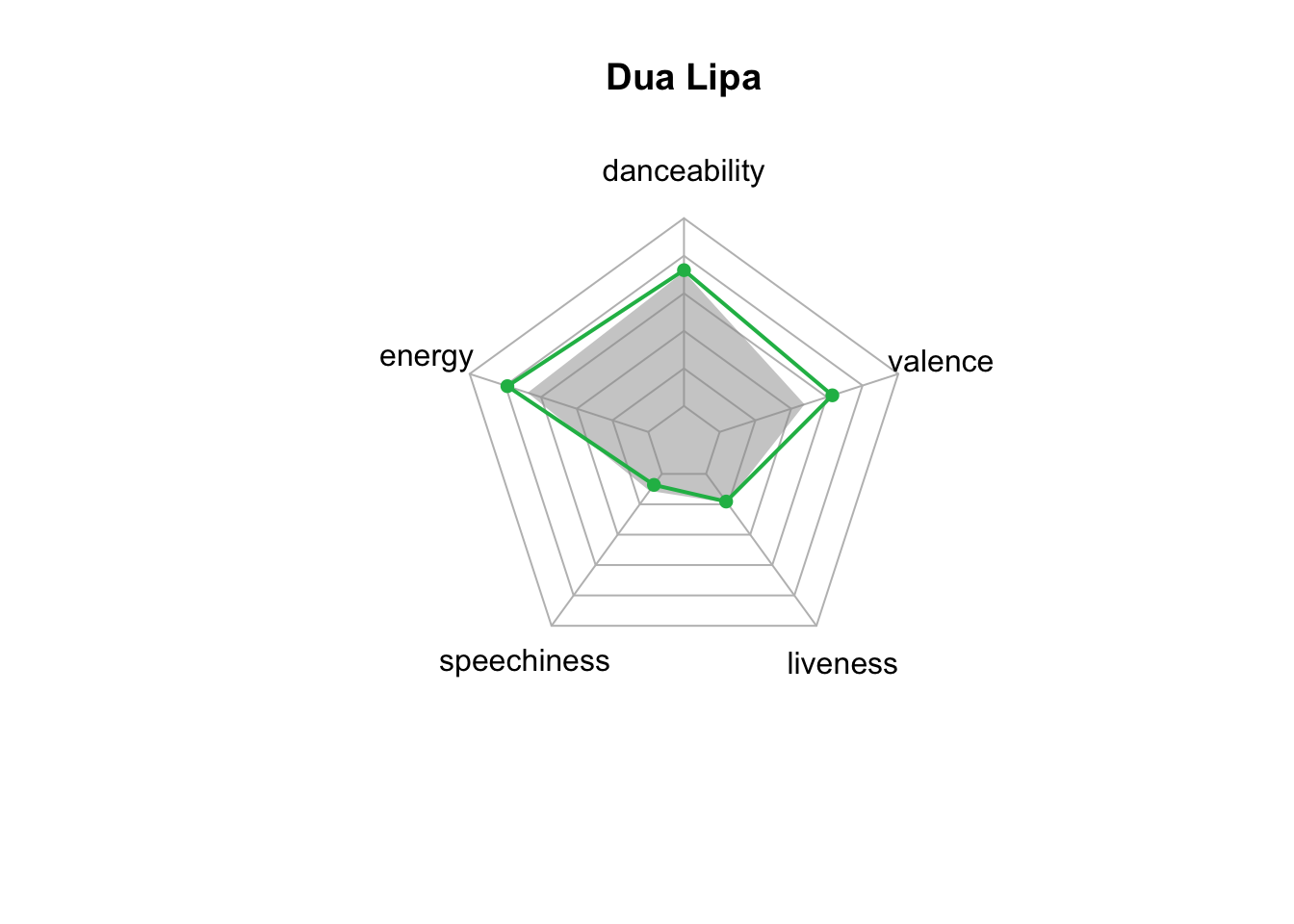
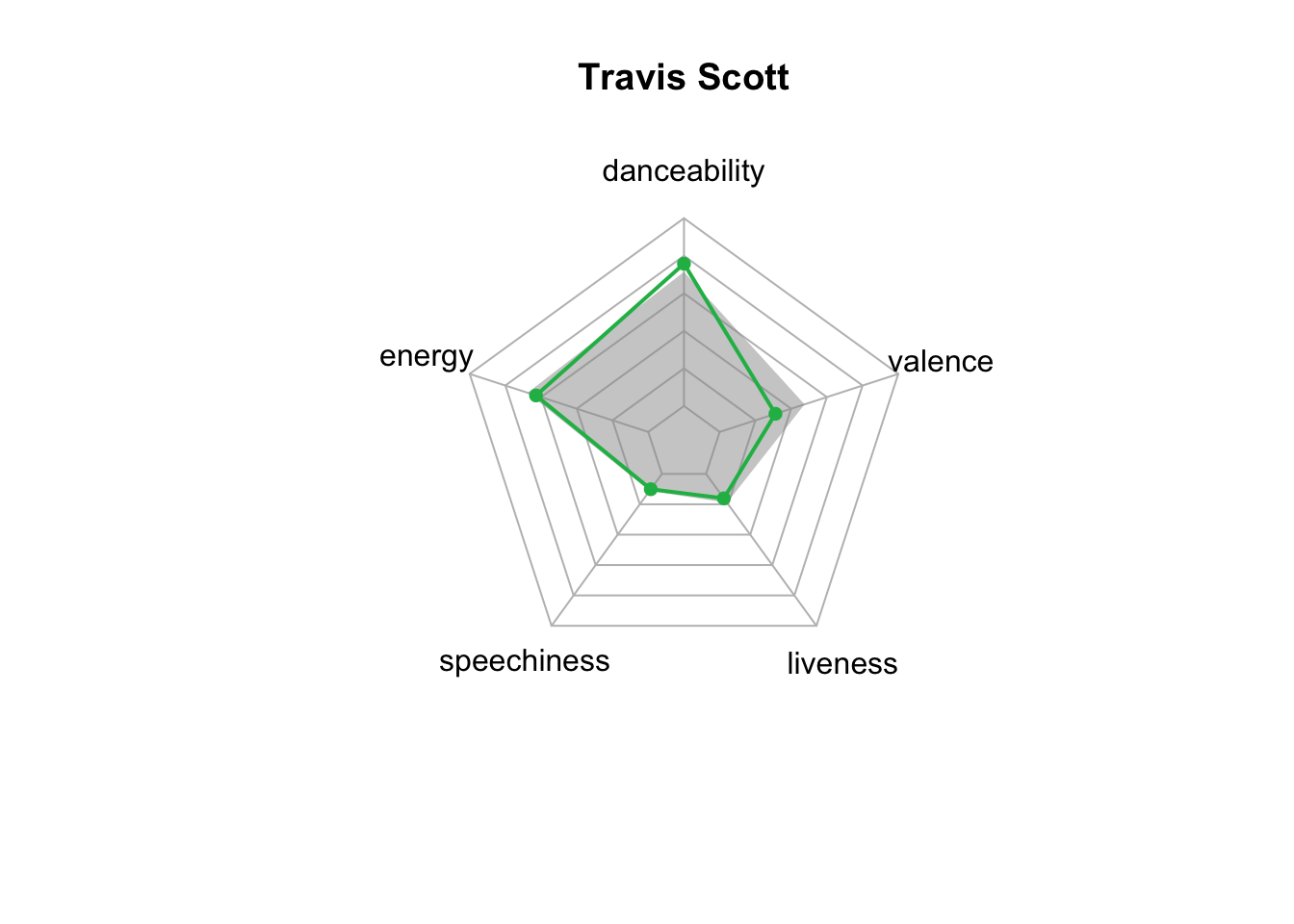
Billie’s radar chart shows she’s a bit of an anomaly, her songs are lower on the supposed top 3 most important features and yet, she’s a top artist. Dua Lipa’s songs exceed in energy and valence, and that might be the reason why her songs are so high charting. Travis Scott’s song feature distribution is relatively similar to the averages. The radar charts of Billie and Travis goes to show how music can’t exactly be boxed and manufactured to produce a hit song.
Big picture: trends over time
We’ve analyzed top songs in 2020. Now, let’s take a step back and explore how the trend has changed throughout the years of 2018, 2019 and 2020.
Liveness and speechiness of songs have consistently low values with slight variations, further highlighting that they are not the features that characterize top songs. The most notable changes is the increase in energy and the decrease in valence. It seems contradictory, but some sad songs could be full of energy. An example (not in any of this data) could be Bohemian Rhapsody by Queen.
Music release timeline
When is the best time to release music? A google search says January and February, since in the first two months of the year, the market is less saturated. Let’s investigate this with our data.
The filter in this dashboard can be activated to only show data for a specific year.
At first glance, our data kind of lines up with the case to release music in Jan/Feb. Throughout the 3 years, more top songs are being released in the first half.
However, at a closer look, the higher ranking songs appear at the last quarter of the year. The months where the average ranking of top songs are the highest for 2020 is August, for 2019 is December, and for 2018 is October. In August 2020, while the number of songs released during this month isn’t the most, the average ranking of those songs are the highest.
The perfect song - does it exist?
From our analysis, a hit song needs to have these features:
High in danceability, energy and valence
Either be an “Angry” mood or “Happy” mood
Released as a single
By Billie Eilish, Dua Lipa or Travis Scott
Be released in August or October 2020
The only 2 songs that fit these critera: Don’t Start Now - Dua Lipa, and HIGHEST IN THE ROOM - Travis Scott. We’ve cracked the code, we know how to make a hit song for 2020, right?
We could build a deep learning network using all Spotify data, and even now there’s an entire industry built around AI services to create music, such as Amper Music, Google Magenta’s NSynth Super, and Spotify’s very own Creator Technology Research Lab. But at the end of it, music is creative. It’s not supposed to be about hitting the right boxes for it to become a top song, it’s about an artist and their unique, individualized creative flair. These analytical tools and technology won’t be able to replicate that and replace musicians, it can only further enable musicians. This analysis was an insightful look into the features of top songs, but it is not able to answer what exactly makes a hit song, or how to create a hit song.